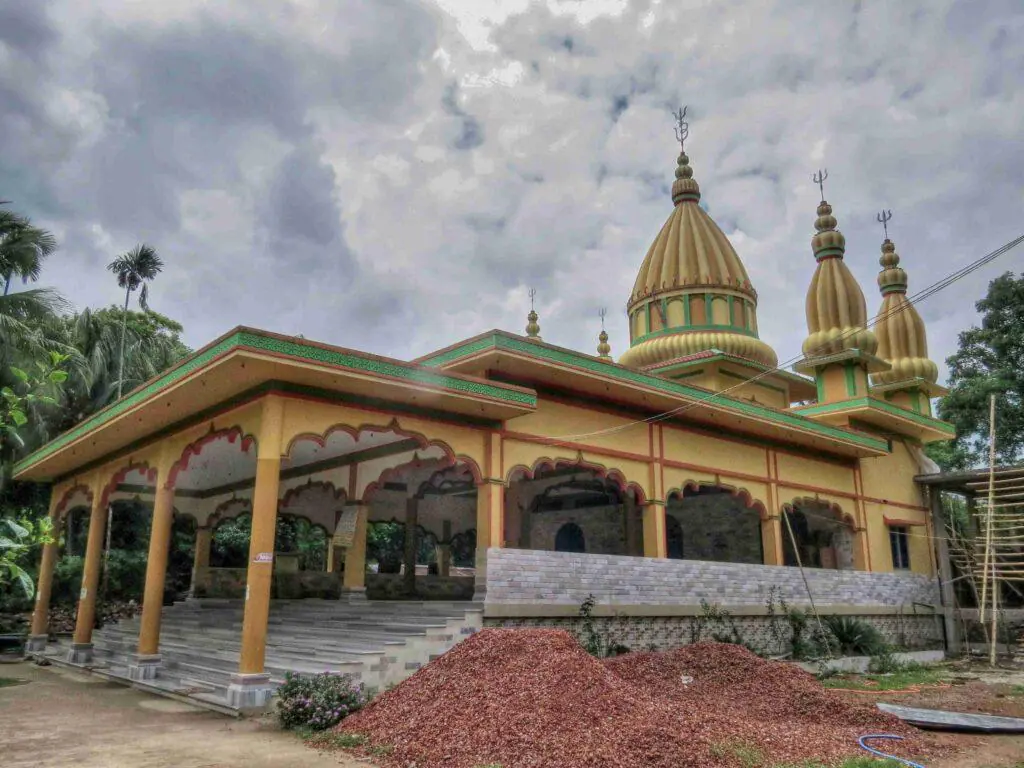
From the kings of Jaintiapur to the heritage diplomats of today — a sacred site that has remained a constant through every age it has lived through.
The Jaintia Kingdom was a sovereign Hindu polity that ruled across present-day Sylhet District (Bangladesh) and the western Khasi-Jaintia Hills (Meghalaya, India) until its absorption by the British in 1835. Its rulers, the Sutnga–Jaintia kings, traced their descent to a local mother-goddess tradition and were committed patrons of Shakta worship.
Under their patronage, Jaintia Shaktipeeth received continuous royal support — endowments of land, ritual provisions, the protection of priestly families, and the construction of supporting tanks, courts and access paths. The kingdom's capital at Jaintiapur, only a short distance from Bourbhag, made the shrine a significant ritual centre of state.
This royal patronage explains the deep continuity of practice at Jaintia — the temple was never an isolated village shrine, but an institution embedded in the religious life of an entire kingdom.
Sylhet sits at one of the great cultural confluences of South Asia. Its plain has been settled by Bengali, Assamese, Khasi and Jaintia peoples; its rivers have carried trade, scripture, and migration for two thousand years; its hills have nurtured Shaiva, Shakta, Vaishnava and Buddhist traditions in close proximity.
It is the homeland of the medieval saint Shri Chaitanya Mahaprabhu's ancestral family, and a centre of Sufi mystic Hazrat Shah Jalal — making it a unique geography in which multiple devotional traditions have shared space without losing their distinctive textures.
Within this rich confluence, Jaintia Shaktipeeth holds its own distinct station — a Shakta sanctuary preserved in a region defined by openness, layering and exchange.
Jaintia's design is best understood not in isolation but as part of a sacred precinct — sanctum, water, stone, hill and grove forming a single ritual diagram.
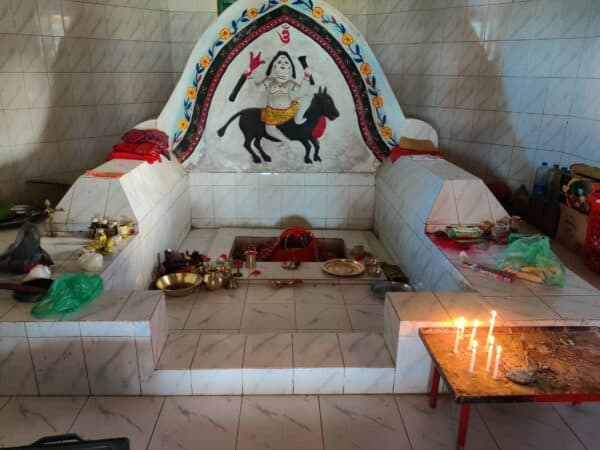
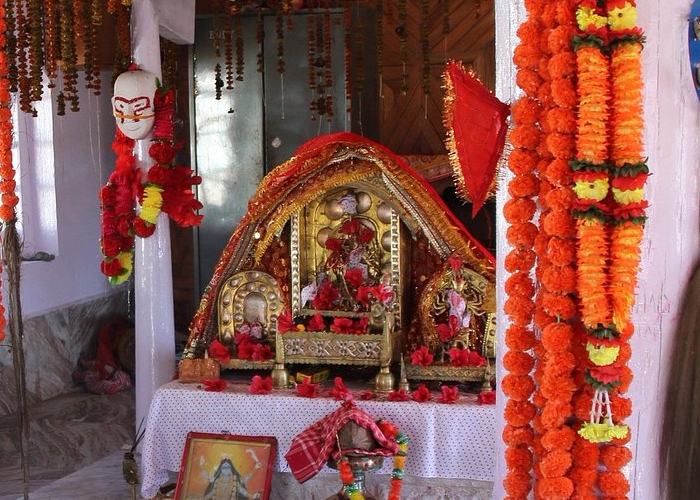
The inner shrine houses the consecrated emblem of Devi Jayanti. The compactness of the sanctum, its low ceiling and its careful orientation reflect a vernacular temple style adapted to the rainfall-heavy environment of Sylhet.
Traditional shrines of the region included consecrated water bodies — for ritual purification, for cooling the climate, and for embodying the lunar feminine principle. Jaintia's water heritage echoes the deeper Shakta link of Goddess to flow.
The temple is approached through a layered landscape — fields, groves, hill ridges. The journey itself is part of the rite. Sacred geography teaches that approaching is half of meeting.
Jaintia is one of the rare ancient Hindu shrines of Bangladesh that has remained in continuous worship — making it a primary cultural witness to centuries of regional history.
Its preservation maintains a living thread of cultural inheritance shared between India and Bangladesh — beyond political tensions, beyond temporal politics.
For pilgrims of the 51-Peetha tradition, the loss or neglect of any single Peetha would tear the body of the Goddess Herself. Jaintia's protection is therefore a duty of the whole tradition.
In an age when cross-border cooperation often hinges on visible diplomacy, Jaintia Shaktipeeth offers something quieter and arguably stronger — a shared cultural inheritance that pre-dates and outlasts political arrangements.
Heritage diplomacy through Jaintia can take many forms: joint conservation, scholarly exchange, religious tourism corridors, NRI engagement, and youth-led cultural programmes that invite young South Asians to encounter their shared past in a single sacred place.
The shrine is therefore not only a destination of devotion. It is a site of soft power — a location where Bangladesh's Hindu cultural heritage and India's civilisational memory meet in a way that strengthens both nations.